How Far Can We Push Low-Carbon Concrete?


A decade of development behind RESHAPE Concrete
UPB's journey towards lower-carbon concrete began in 2015 with the publication of our first Environmental Product Declarations (EPDs). Over the following decade, our scientists and product specialists tested alternative binders and optimised concrete production processes. We also invested in a new production facility equipped with a wastewater recycling system and other technologies designed to support more environmentally responsible manufacturing.
Meeting Svensk Betong lvl 4 standarts
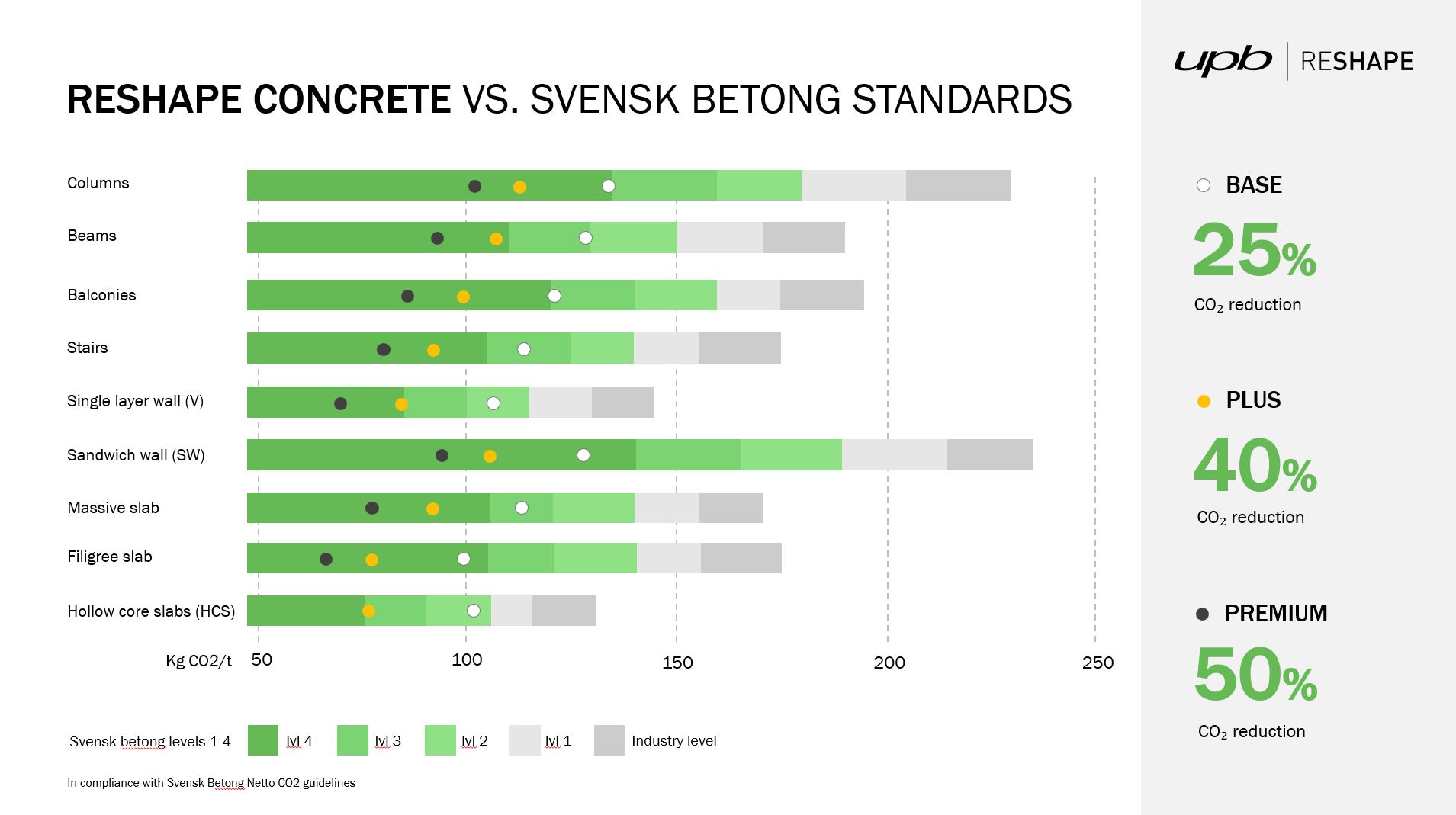
RESHAPE Concrete is available in three levels - base, plus and premium - each targeting a different degree of emission reduction. The chart shows the volume of CO2 emissions per tonne for specific precast product groups under different Reshape concrete strategies. As we see for a number of product groups Reshape concrete Premium strategy allows to reach emission levels as low, as 70-100 CO2 kg/tonne and reach Svensk betong industry level 4.
There is no single substitute for clinker
To achieve this, our specialists developed concrete mixtures using alternative binders that reduce clinker content while maintaining the required technical performance.
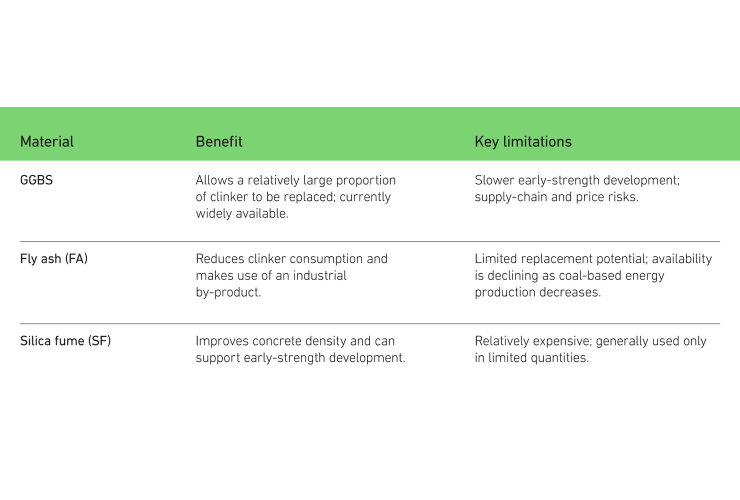
The most widely used supplementary materials are fly ash and silica fume. To get even greater emission reductions, we have also incorporated ground granulated blast-furnace slag into selected mixes.
Each material contributes unique properties to the concrete and helps maintain the performance expected from the traditional concrete. At the same time, each comes with its own limitations, whether related to availability, cost, supply stability or technical performance.
As the long-term availability of some supplementary materials becomes less certain, we continue to explore new alternatives. Potential solutions include metakaolin, limestone, oil-shale ash and olivin. While each presents promising opportunities, their implementation requires careful evaluation. Therefore there is no single clinker substitute that can meet the requirements of every application.

Knowing where not to compromise
Not every RESHAPE Concrete performance level is currently available for all precast structures. For example, the highest CO₂ reduction level can't be used for certain external elements exposed to freeze-thaw and salts.
The long-term performance of the relevant binder combinations must be fully validated under these demanding conditions before wider implementation.

Architectural concrete brings another challenge
Changes in binder composition can affect the tone and colour consistency of pigmented surfaces. Further development is therefore needed to achieve the highest emission reductions while preserving the intended architectural finish.
These are not obstacles to overlook. They are technical boundaries that must be understood, tested and addressed responsibly. Lower embodied carbon cannot come at the expense of durability - because an element that requires premature repair or replacement quickly loses much of its original environmental benefit.
Low-carbon concrete is only part of the answer
RESHAPE Concrete continues to evolve through ongoing research, verified performance data and experience gained from our projects. Next steps include extending its range of applications, refining binder combinations, and evaluating emerging technologies such as carbon-captured cement and new mineral-based alternatives. We are also pursuing a wide range of project-specific measures beyond the concrete mix itself, including lower-carbon reinforcement and other solutions tailored to each project’s technical and sustainability requirements.

Integrated expertise creates the greatest value
Meaningful reductions can't be achieved through the concrete recipe alone. Structural optimisation can lower the volume of concrete required.
Controlled off-site production reduces waste and provides greater consistency in material use and quality. Better planning helps prevent overproduction and non-conforming elements, while design for disassembly can enable components to be reused in the future.