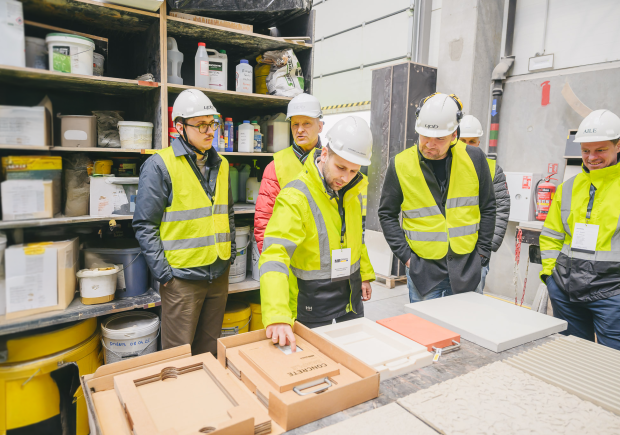
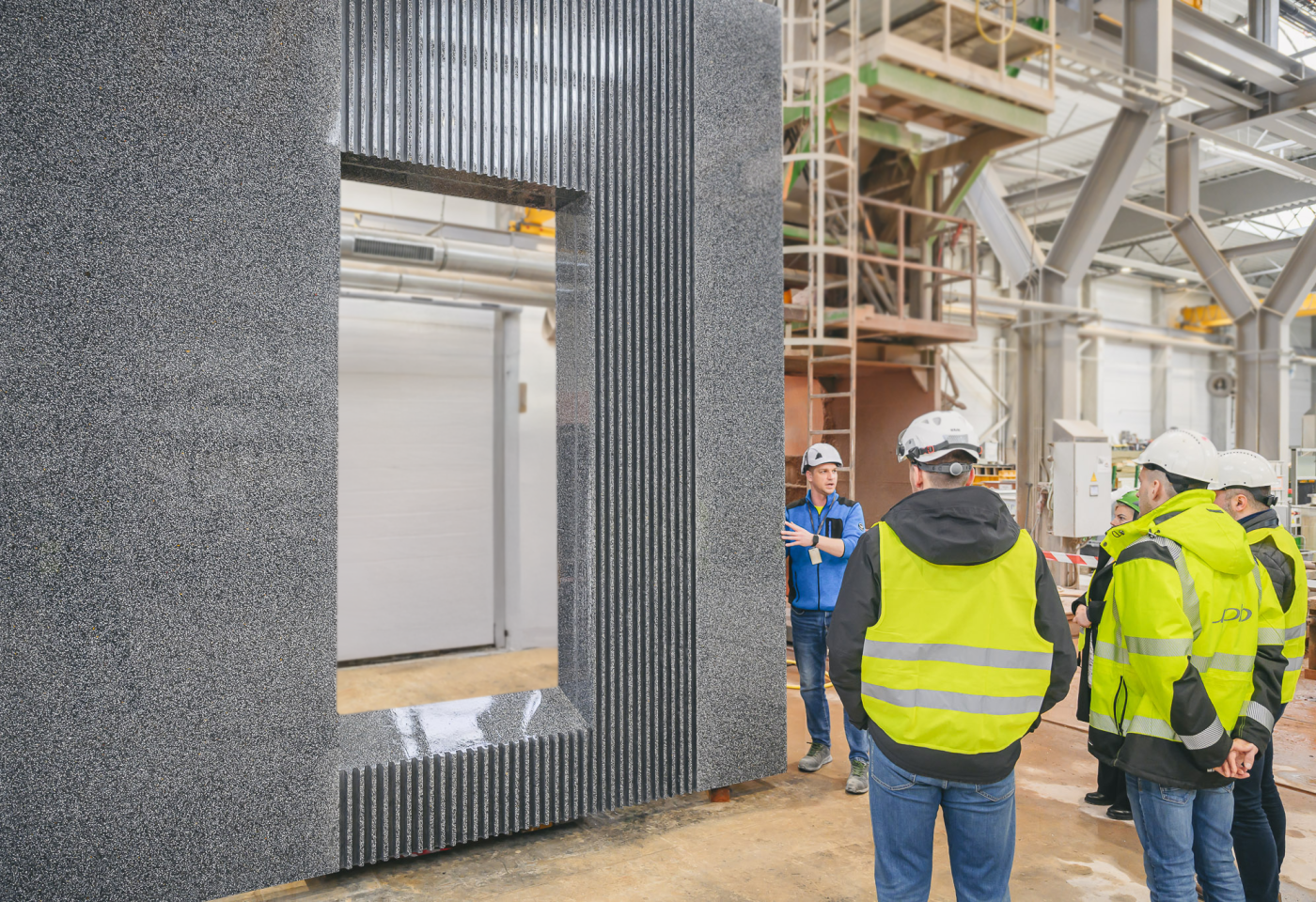
Early technical involvement enables structural optimisation, more efficient use of materials, and informed choices that influence both environmental performance and cost. This approach is particularly relevant in projects with a high degree of prefabrication, where engineering decisions directly affect production, transport, and assembly. says Arturs Gulbis, UPB Local Manager in Denmark. “With our integrated engineering, production, and construction capabilities, we have broad set of toolbox to help projects meet their climate targets” adds Gulbis.
This approach is supported by life-cycle assessment (LCA), including particular attention to logistics (A4 stage), where transport emissions are reduced through efficient route planning and the use of fossil-free fuels.
Proof in practice
A clear example of this approach can be seen in Skanska’s office development Olivin in Stockholm, where UPB was engaged early to reduce embodied CO2, while integrating reused structural elements.
By optimising structural design, advising on more climate-efficient façade solution, selecting low-carbon materials, and integrating reused hollow-core slabs into the building structure, the project achieved 30% reduction in embodied CO₂ alongside 8.9% cost savings. “If we would be assigned to the project after the design phase was completed, none of these results would have been achievable,” Gulbis adds.
Low-carbon concrete
Alongside project-level optimisation, UPB has invested in reducing emissions at product level, through its low-carbon concrete product line – RESHAPE concrete – It has been widely applied in developments across Scandinavia, delivering on average 20–30% CO₂ reduction in completed projects.
According to PhD. Arturs Lukasenoks, Technical Director of UPB’s Precast Division, achieving this requires extensive testing to maintain strength and durability. “The key lies in systematic clinker reduction and efficient, zero-waste manufacturing,” he explains.
The RESHAPE concrete achieves up to 70% clinker substitution using supplementary cementitious materials such as ground granulated blast-furnace slag (GGBS), fly ash, and silica fume. Available in three performance levels, it can be tailored to technical requirements, exposure classes, and project-specific environmental targets.
Some applications remain under development. For example, the highest CO₂-reduction level is not yet suitable for outer-layer elements, as the binders used for this product have not been fully verified yet for the application in environments exposed to freeze-thaw and salt. Also, architectural façade elements are not yet suitable as they interfere with the saturation and color of pigmentation.
We are expanding the applicability of this product line to additional exposure classes and environments and at the same time, we are testing further innovations, including carbon-captured cement, mineral-based solutions such as olivine, and circular approaches like integrating reclaimed materials into prefabricated elements,” Lukasenoks explains. “For example, in a recent project, reclaimed bricks were carefully incorporated into prefabricated concrete panels for the building façade, maintaining both architectural quality and structural performance. When projects call for it, these approaches offer further potential, he adds.
Meaningful CO₂ reduction in construction is ultimately driven by informed decisions made early in the process. Experience from practice shows that combining early engineering involvement, prefabrication, low-carbon materials, and circular solutions creates the conditions for measurable environmental gains - without compromising structural performance, architectural quality, or cost efficiency.