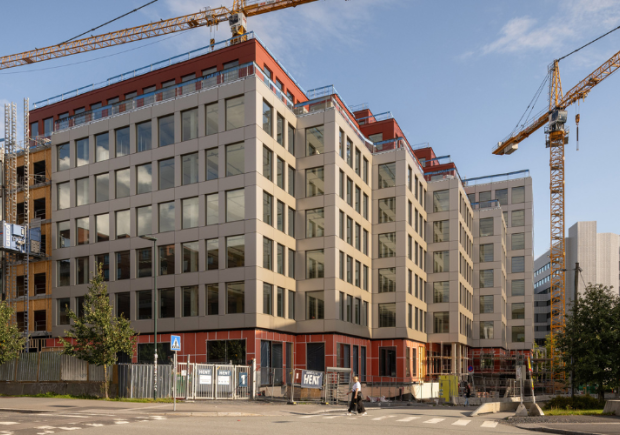
As part of the construction of Olivin, Skanska's new headquarters in Stockholm, UPB handled design, production and assembly of the framework structures. This included the integration of reused hollow-core slabs, prefabricated concrete façade walls and aluminium-clad windows.
"UPB was invited to join the project at an early stage with a specific task from the employer Skanska, to find ways to reduce the project's environmental footprint by 30%. This required rethinking structural solutions, material choices, and construction methods already at the design stage," says Jānis Šimanskis, UPB Head of Sales Framework Structures.
From design decisions to measurable results
In the facade, steel columns and beams were replaced with prefabricated concrete wall elements. The structural frame was further optimised by refining the column and beam layout, adjusting slab sizes and orientations, and integrating a timber glulam structure for the cantilevered part to reduce its weight and minimise loads on the primary structure.
From a materials perspective, we used concrete products with 50% clinker substitution and steel components with a higher recycled content.
As a result, the carbon footprint of the structural frame was reduced from 139 kg CO₂/m² to 99 kg CO₂/m², the project timeline was shortened, and overall costs were reduced by 8.9 percent.
"What is particularly notable is the speed of these optimisations. They were developed, validated and incorporated in the design within less than three months, made possible by our ability to provide a clear understanding of how each early design decision impacted both CO₂ emissions and project costs," says Šimanskis.
Integrating re-used structural elements
"Another major challenge was the integration of reused hollow-core slabs into the building structure. It became a project within a project, requiring extra time and resources in design and assembly coordination," adds project manager Armands Andersons.
Without established networks, sourcing suitable elements is complex. It is difficult to find donor buildings that match the needs of a new project, and once they are found, their condition, service life, and certification must be carefully verified.